Stats Show AP Courses May Not Be the Answer to Less Student Debt

Student debt levels have been rising and have recently reached $1.2 trillion in outstanding loans. One solution to helping students reduce their debt is to have them graduate in four years or even a semester early since student loans tend to really add up beginning in the fifth year of college. Passing Advanced Placement (AP) courses in high school allows students to get college credit before they arrive on campus,  giving them a leg up on graduating on time. AP courses have also been touted as an opportunity for students to experience the rigors of university courses – thus preparing them for better success in their freshman year.

An analysis by Politico shows that AP courses haven’t been making the grade. They state that

Enrollment in AP classes has soared. But data analyzed by POLITICO shows that the number of kids who bomb the AP exams is growing even more rapidly. The class of 2012, for instance, failed nearly 1.3 million AP exams during their high school careers. That’s a lot of time and money down the drain; research shows that students don’t reap any measurable benefit from AP classes unless they do well enough to pass the $89 end-of-course exam.

In its annual reports, the nonprofit College Board, which runs the Advanced Placement program, emphasizes the positive: The percentage of students who pass at least one AP exam during high school has been rising steadily. Because so many students now take more than one AP class, however, the overall pass rate dropped from 61 percent for the class of 2002 to 57 percent for the class of 2012.

Even more striking: The share of exams that earned the lowest possible score jumped from 14 percent to 22 percent, according to College Board data.

Further,

Advanced Placement classes, available in 34 subjects from art history to calculus, are supposed to be taught at a college level. The exams are graded on a scale of 1 to 5. The College Board considers 3 a passing grade, though fully a third of the universities that grant college credit for AP require a score of 4 or 5. Dartmouth College, questioning the program’s rigor, has announced it will soon stop accepting any AP scores for credit.


Advocates often argue that students benefit from being exposed to the high expectations of an AP class, even if they don’t pass the test. Yet there’s no proof that’s true.


In fact, taking an AP class does not lead to better grades in college, higher college graduation rates, or any other tangible benefit — unless the student does well enough to pass the AP test, said Trevor Packer, a senior vice president at the College Board.

For access the Politico article, please click here.
Student Loans for Toddlers?

New York City mayoral candidate Christine Quinn has created a new program to help the middle class pay for expensive day care by offering student loans. In a column titled “Owe, Baby, NYC”, The New York Post describes this “first of its kind” pilot project:

The program…allows Neighborhood Trust Financial Partners, a local credit union, to offer 6-percent-interest loans through a $300,000 city subsidy. Families with children between the ages of 2 and 4 can get loans up to $11,000. In the first year, they’ll be available to 40 eligible families….New York City has some of the highest child-care costs in the country, averaging $13,000 per year, according to the Center for Children’s Initiatives. Applicants must have an annual income of $80,000 to $200,000, a credit score of at least 620 and agree to attend a free financial counseling session with a Neighborhood Trust counselor. Once parents are approved, the payments will be disbursed directly to the day-care providers. The program also allows parents to make interest-only payments until their children reach kindergarten-eligible age.

This is a surprising development given the current national discussion about college student loans. According to a study by the federal government’s Consumer Financial Protection Bureau there is $1.2 trillion in outstanding student loans ($1 trillion through the federal government). Currently 1 out of 8 student loan borrowers is in default.

Given these statistics is it wise to extend student loans to the parents of toddlers? Matthew Yglesias of Slate says no.  He differentiates college and preschool loans in the following way:

Perhaps the best way to understand the problems here is to start with the deep logic behind student loans for college. College is expensive, and difficulty paying the tuition bill can be a major barrier to attending or completing college. Yet completing college appears to be quite financially rewarding, with degree-holders earning a lot more money over the course of their lives than those who don’t have a college degree. So it’s a very natural situation for a credit market to arise. Having the money to cover your college tuition makes you much more likely to be able to repay the loan in the future….

Day care lending, meanwhile, has basically none of the features that make college tuition loans seem attractive. Being able to get a loan for your 3-year-old to get some child care doesn’t in any clear way increase your income three, five, or 10 years down the road. For lots of hard-pressed New York families, a loan like this is going to be a great lifeline out of a difficult situation. But down the road, you’re going to end up with a new set of difficult situations as people struggle to repay the loans.

Ultimately the voters of New York City will decide on the wisdom of City Council Speaker Quinn’s plan when they vote for mayor.

CSCubed Featured in Delaware County Times Story on Student Loans

The recent spike in interest rates for federally subsidized Stafford Loans has captured a lot of media attention. As of July 1, the rates jumped from 3.4% to 6.8% for new loans. An article in today’s Daily Times of Delaware County includes commentary from one of our members, Dr. Wes Leckrone of Widener University (click here for article).

Journalist Danielle Lynch writes:

Wes Leckrone, an associate professor of political science at Widener University in Chester, said a group of students at Widener are concerned about college costs, too. Those students formed an organization called College Students Concerned by College Costs under his direction during an honors American government course in the fall 2012 semester.

She then mentions CSCubed’s advocacy positions:

Leckrone said the Widener student group advocated for a bill in Harrisburg in mid-April that would have made more Pennsylvania Higher Education Assistance Agency grants available for middle-income students. The Widener University students joined the Association of Independent Colleges and Universities in Harrisburg to advocate for Senate Bill 420. The bill is currently in the state Senate Education Committee. “We push for grants instead of loans because grants make college more affordable,” he said.

At the end of the day this is basically just politics as usual:


Leckrone said that even if the interest rates increase on the subsidized loans, the government is paying the interest on the loans while the students are in college. “At the end of the day this still is really a great program,” he said. Leckrone described the debate over this issue as “great political football.” Similar to McClean, he said this is just another example of things not getting done in Washington. “Republicans want to peg interest rates to the market and Democrats are arguing this is just another way college costs are increasing for the middle class,” he said.

For continued updates on student loan interest rates and other topics related to higher education costs please follow us at https://www.facebook.com/CSCCubed or https://twitter.com/CSC_Cubed

Cutting Credit for AP Courses: Is This About Money?

A recent article in the Pittsburgh Tribune-Review by Kate Wilcox discusses an emerging trend where colleges are either cutting credit for high school AP courses or raising the standards for test scores. Colleges argue that these changes are necessary to guarantee that students attain the proper academic rigor in core courses. Dominick Frollini Jr., a high school chemistry teacher thinks there might be other motives:


“You’ve got to look at the perspective of AP and the perspective of the university,” he said. “Both have a vested interest in whether or not you take the exam or whether or not you take the course. There’s some money issues.”


Frollini touched on an issue bandied about on Internet blogs where some have questioned whether colleges are tightening AP requirements to ensure that students will have to pay for classes they might be able to forgo because of their AP courses.

Receiving AP college credits helps students to graduate on time (and sometimes early!) which is an important factor in lowering their student loan debt load. Perhaps colleges need to re-evaluate the trend discussed in this article.

What would Student Loan Rate Hikes Mean for the Average Borrower?

Today’s Philadelphia Inquirer has an editorial calling on Congress to address the coming spike in student loan interest rates. Legislative inactivity will cause rates to spike from 3.4% to 6.8% per year beginning July 1. To see what that means to people with student loans let’s take a look at the numbers. According the Project on Student Debt, the average level of student loan debt for college graduates in 2011 was $26,600. This level of debt, paid over a 10 year term, @ 3.4% would require a monthly payment of $261.79 according to a loan calculator.  The same loan @ 6.8% would require a monthly payment of $306.11 0r an increase of $44.32 per month. This number doesn’t seem particularly egregious, but when you factor this over the course of a ten year loan it means that graduates would pay an addition $5318.40.

The Inquirer notes that all of the existing plans for addressing the student loan rate spike are inadequate. According to the editorial

None of these plans recognizes the tremendous public benefit of an educated populace. People with postsecondary education are more likely to become self-sufficient, taxpaying members of the middle class. That contribution to the greater good and to democracy is worth something.

This is food for thought as Congress debates how to keep college affordable.


College Debt, Planning and Just Saying No

NPR’s Morning Edition conducted a valuable interview on college debt with Ron Lieber of the New York Times (Debt and the Modern Parent of College Kids).  Mr. Lieber provided tough, but common sense,  solutions to the problems of financing education. Two parts of the discussion stand out.

First, he suggested that parents think of funding college in three 33% increments (the 20/20/20 plan if education were to cost $60K over four years) . First, parents could save one third of the costs of college over the period of 18 years through a manageable savings plan. Second, they could pay 1/3 of the costs out of pocket while their child was in school. He stated

“It might mean some sacrifices — some very careful budgeting, a lot of rice and beans on the table — but it’s doable.”

The final third of higher education costs could be subsidized through federal loans.  The 20/20/20 plan seems sensible because

[w]hen you start to divide it into chunks, it starts to seem at least within the realm of the possible.

Mr. Lieber’s second useful suggestion involved a bit of pragmatic toughlove for parents. He says that sometimes emotions have to be trumped by rationality when children get accepted to a top tier school.

[T]here’s this feeling of ‘Can I or should I say no to my child who wants to go to a $60,000-a-year school when they’ve already gotten admission to the flagship public university in our state that only costs $20,000?’ And then there’s the question of ‘Is it worth it? What am I getting for the extra $40,000 and would we be able to pay our own debt back if we were to support the dream of our child?’ These are all deeply emotional decisions, and you have to begin by acknowledging that it’s feelings that are on the table first before you look at the hard science of the numbers.

Please listen to the rest of the story for more information on what types of loans to take out and whether it is worth it to borrow against retirement.

Young Adult Borrowing is Down, While Student Loan Debt is Up

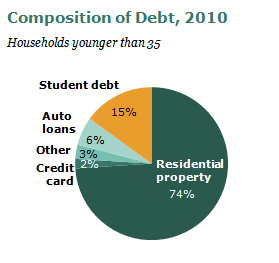
The Pew Research Center recently released Young Adults After the Recession: Fewer Homes, Fewer Cars, Less Debt. The study examines the borrowing habits of younger Americans over the last decade. The report concludes that they are taking on less debt, primarily in the areas of home mortgages and car loans. In part this is the consequence of delayed marriage and household formation among the younger demographic group. The Pew study found that “the median debt of households headed by those younger than 35 fell from 2001 ($17,938) to 2010 ($15,473).”

Unfortunately, the only type of debt to increase in recent years has been from student loans. Pew found that

Student debt was the only major type of debt to increase in prevalence among young households during the recession. In 2007, 34% of young households had outstanding student debt. By 2010, 40% of younger households had student debt. However, the median amount owed by households with student debt fell from $14,102 in 2007 to $13,410 in 2010.

This number is up substantially from 2001 when only 26% of younger households had outstanding student loan debt. Debt from student loans has also increased as a proportion of outstanding debt: from 7% in 2001 to 15% in 2010.

Composition_of_Young_Household_Debt