Here’s a copy of our new CSCubed Poster!
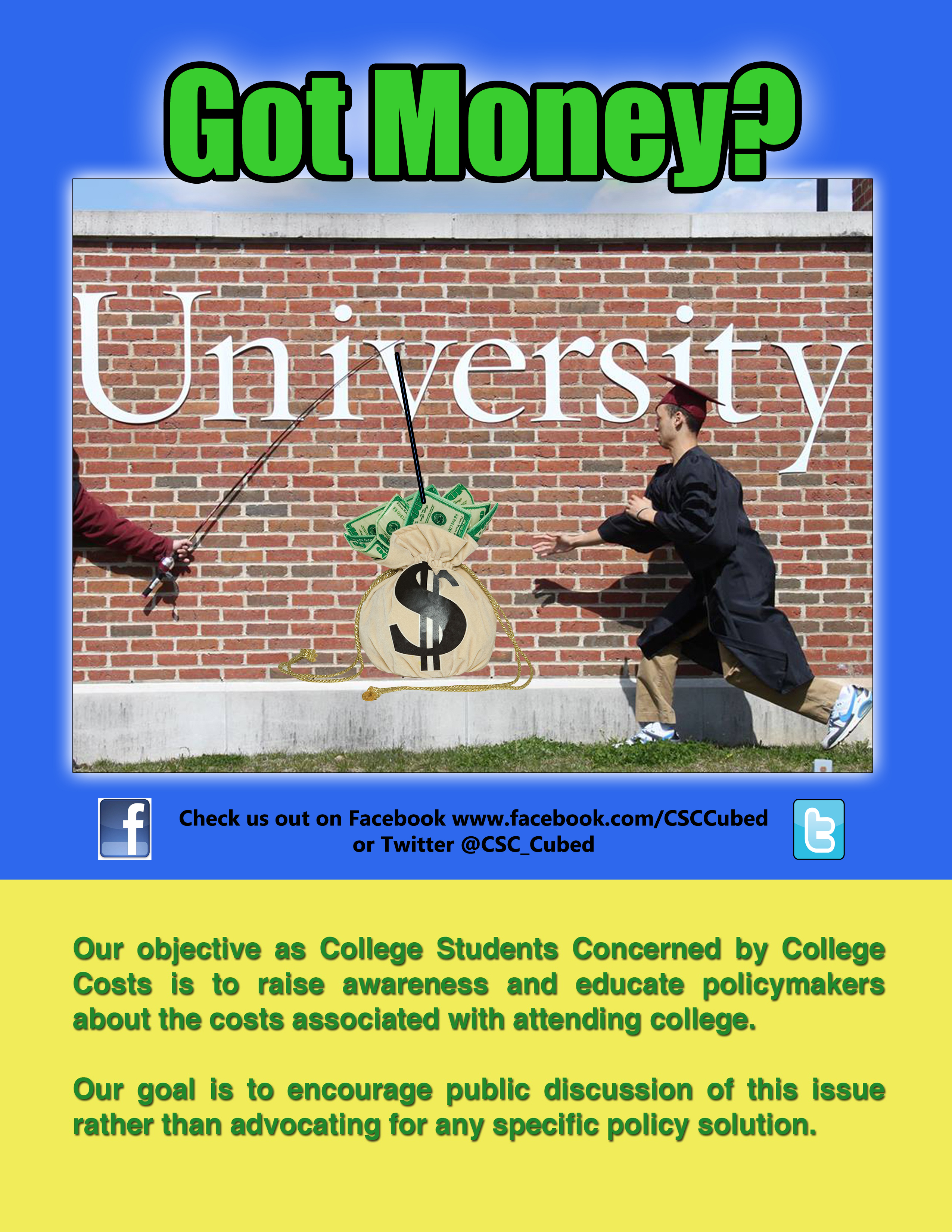

Here’s a copy of our new CSCubed Poster!
by Marissa Daniels-Benditt
In today’s world, earning a college diploma is considered the key to success. However, when the cost of college is too high and you’re swimming in debt after you graduate you don’t feel so successful. According to the New York Times, There may be a way to fix this.
A majority of Americans turn to the government for financial aid which is based off of the Expected Family Contribution (EFC). The EFC formula uses the financial information a student provides on his or her FASFA to calculate the how much aid they are entitled to.
Believe it or not, the way to cut college costs is by eliminating Congress’ power over the EFC formula. Congress is trying to make the EFC more realistic but there are already so many problems with it that it is unable to be fixed. The New York Times article says that the EFC should be cut by 75 percent and by doing so it would force colleges to construct finanical aid packages without the “artificial price supports of inflated contribution numbers—and make paying for college less agonizing.”
Do you think this could be a way to lower college costs? If this is a plausible way, do you think that it would pass?
Keep in mind, lobbying expenditures by colleges, universities and other higher-education organizations have totaled more than a half-billion dollars over the past five years. Making them the 8th highest interest group attempting to influence Congress!
http://www.nytimes.com/2014/03/21/opinion/a-quick-way-to-cut-college-costs.html?_r=0
by Philip Wubbolt
Legislation in the Pennsylvania legislature will allow several Pennsylvania public colleges to pull out of the 14 university system of higher education. Supporters of the bill say it would strengthen the state system by allowing its best universities to leave while those who oppose it say it would hurt the system because it would result in increased tution and weakened faculty unions. Many trustees and lawmakers are pushing for this bill to be approved. The bill would allow PASSHE’s best off institutions, those with over 7,000 students and good financials, to become “state-related” versus “state-owned”. The epicenter for support is West Chester University.
The sheer fact that this kinds of rash actions are on the minds of lawmakers and trustees shows the failures of the state-school system as a whole. The belief is that leaders at privatized universities will be able to run a higher education system better than the government.
http://www.insidehighered.com/news/2014/03/21/universities-want-out-pennsylvanias-higher-ed-system
CSCubed had a successful Student Lobby Day in Harrisburg on April 1. We contacted more than 50 members of the Pennsylvania legislature seeking support for middle income college grants. Several media organizations covered our trip including KYW-AM who us as we left before dawn. Their story ran regularly on the radio during drive time and was published here: “Widener Students in Harrisburg to Lobby for College Debt Relief”

Picture of CSCubed members getting on the bus to Harrisburg
We’re off to Harrisburg bright and early tomorrow morning for the annual AICUP Student Lobby Day. We’re asking state legislators to support the following legislation:
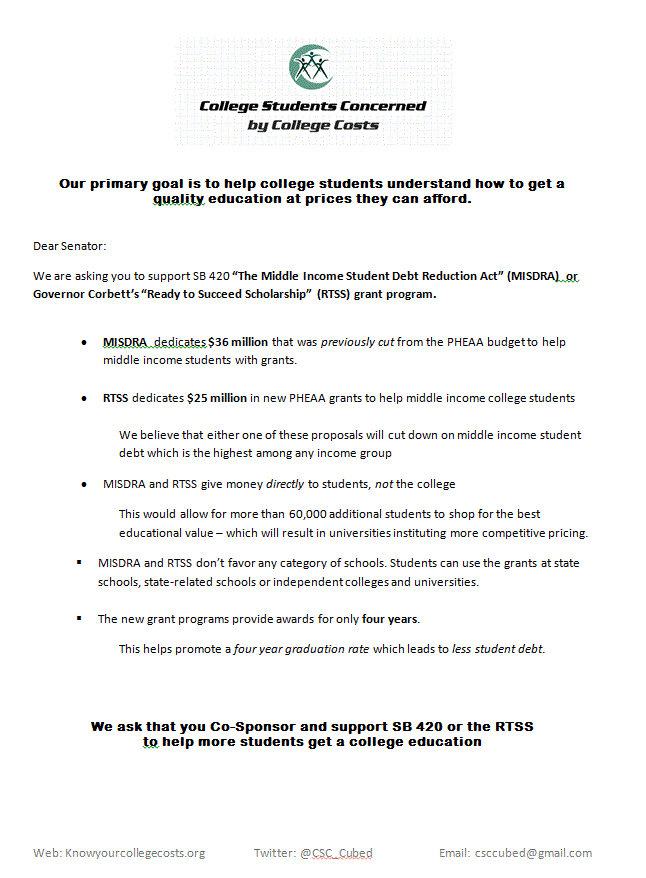
You can follow our advocacy efforts on Twitter @CSC_Cubed and #StudentLobbyDay.
Remember the concepts you learned in your first economics class? GDP, unemployment rates, pricing etc. It turns out, one of those concepts are the very reason for the price of college today. According to Pascal-Emmanuel Gobry from Forbes.com, the reason for the high price of college is actually painfully obvious. He says that if you increase the want or need for something without increasing the amount you have, then the price will go up in a free market. Prices are signals in a capitalistic market economy. When a price is high, it is either more of a luxury good or it is a highly sought after good. Most people do not believe that college is a luxury item so that means that college is very valuable to people. They are willing to pay very high prices to obtain degrees. Because of this willingness and the easy access to tens of thousands of dollars in financial aid from the government, demand for college increased dramatically in the past 30 years. And, not coincidentally, prices sky rocketed too.
Financial Aid loans were meant to help more people get into college and create a more educated workforce. Do these loans really increase the price of college overall? Gobry gives the example that “US colleges that don’t accept Federal loans have tuition roughly half of their similarly-ranked peers.” For colleges that do not accept federal loans from students, the prices are almost half as much as the other colleges. Inflation in tuition for those colleges are substantially less. Even if you are an ardent supporter of higher education in this country, will you support these loans no matter how high prices climb?
CSCubed is preparing for AICUP Student Lobby Day in Harrisburg on April 1. Our primary goal is to convince legislators to commit funding to a new PHEAA grant program that helps middle class students pay for college. Leading up to Lobby Day we’ll be providing more information as to why this new grant program is so important.
AICUP research provides the following information:
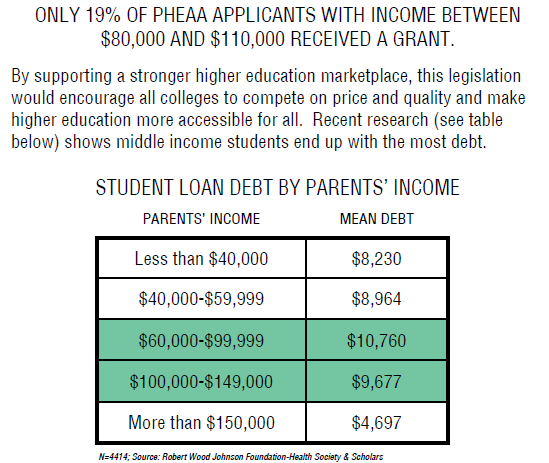
The middle class is hit hardest by student debt because they are not wealthy enough to pay for education out of pocket and not poor enough to qualify for programs like Pell Grants. Consequently the new middle income PHEAA grants that CSCubed supports will help a population that has the most student loan debt of any income category.
Hello to all the parents and prospective students on campus today for Accepted Students Day! Please take a minute to look through the information we provide concerning how to keep the costs of higher education manageable. We provide regular updates on issue related to college so please enter your email and you’ll be notified when we add a new post.
Please also follow us on Twitter @CSC_Cubed and on Facebook (https://www.facebook.com/CSCCubed).
by Kyle Purchase
The issue with higher education is the humongous debt that follows after a student finishes school. In some cases student worry not just about the debt but how to raise money to even complete their education. Thomas Hundley, a political science major at Howard University, has been raising money at his law firm where he works to continue his chance of completion. What he hopes is that President Obama can aid middle-class families like Hundley’s and many other families across the nation. CSCubed’s cause for debt relief of middle class families would also include getting more students to enroll and succeed, rather than stop school and raising enough money to complete. Helping middle income student finance education, rather than having them potentially drop out to work to pay for future schools would help the cause of higher education.
http://articles.philly.com/2013-09-02/news/41665155_1_tuition-college-education-president-obama
by Elizabeth Cohen
A bill introduced in Washington’s legislature proposes that students do not have to worry about paying their college tuition right away. Rather, after leaving school, they would pay a percentage of their income for up to a 25 year period. The “Pay It Forward” program can help a wide variety of people with different incomes afford college. 17 other states have introduced similar legislation. However critics of this program believe we should stick to the programs that already exist, like grants, and add money to those instead of trying to fund brand new programs. Still there are good points listed in the bill such as if a person’s income changes then the amount they pay per month would change as well. This bill would bring many changes to a student’s ability to pay for a college education.
 know your college costs