Limiting For-Profit Institutions from Circumventing the 90/10 Rule

As higher education becomes a necessary part of life, many new institutions are appealing to the less fortunate student. These schools are categorized as for-profit and market their programs to attract anyone willing to listen. They operate by cutting costs and by obtaining money given to students through federal financial aid. Because less fortunate students receive more financial aid for-profit schools attempt to attract this demographic group. The government has a law to limit the amount of money that a university can receive through federal financial aid. Called the 90/10 rule it “requires for-profit colleges to receive 10 percent of their revenue from nonfederal sources to be eligible to receive [up to 90% from] federal student aid.”

However, there are critical flaws to the 90/10 rule. Post 9-11 GI Bill benefits are not counted as federal revenue. As a result, many for-profit schools prey on military veterans. This gap in the law can cause some institutions to receive almost 100% of revenue from the federal government. Opponents argue that for-profit institutions increase tuition when Congress increases federal student aid funding in order to fulfill the rule.

Another loophole involves enrolling international students. Some top for-profit schools, such as EDMC, have Canadian campuses. The Canadian students are not qualified for US financial aid, consequently the tuition they pay is added into the  “10” percent, allow the schools to circumvent the law.

H.R. 340, Protecting Aid for Students and Taxpayers Act, would prevent for-profit institutions from using federal education assistance for advertising, marketing, and recruiting students. This would solve many of the problems with the 90/10 rule and close many of the loopholes.

The critical question then becomes the prioritization of funds: What’s more important, success and resources available to the students or the wad of cash that goes in the pocket of the institution? This may seem drastic, but it seems post-secondary institutions, especially those dedicated to the generation of profit, have become more of a business then a center of learning and growth. Although it’s not a perfect solution, reforming these policies will take our nation a step closer to providing students with more than a paper, a promise, and a plethora of debt when they graduate.
Florida is further than you think: Today’s college graduates won’t be retiring any time soon


by Michael Pacitti

It’s no secret, retirement is a long way away for all recent college graduates. It’s fair to say that they’re worrying about finding a job now, not relaxing on a beach somewhere 40 years down the line. Let’s face it, retirement isn’t exactly a top priority for this demographic. But what if I told you that your retirement wouldn’t happen for an additional ten years?

An alarming prediction from the financial website NerdWallet concludes that the average college student with loan debt of $23,000 on a 10-year repayment plan could translate up to $115,000 less for their retirement fund. I know what you’re asking- who in their right mind would pay in excess of $90,000 of interest on a $23,000 loan? Rest assured the answer (at least in this scenario) is still no one in their right mind. However, there is an economic factor called opportunity cost that is key to the prediction NerdWallet makes. Opportunity cost is the amount of money one could potentially earn if a certain sum was invested with compounding interest rate over a certain period of time. In other words, if the money spent on paying back student loans was instead invested, it would amount to a sum over $130,000 after 33 years. However, if not invested, this ends up costing students ten additional years’ worth of work before having the savings to retire.

Although it is not an issue for the near future, the ability to retire and live comfortably is a goal almost all people strive for. With the rising cost of student loans, this goal drifts farther and farther away from recent grads until eventually staying out of their reach.

Federal Ratings for College?

by Marie Herb 

Higher Education Politics are a hairy place to be right now. From all ends of the spectrum people are struggling. High school students applying to college are struggling trying to find ways to pay for college, College students are struggling to pay back part of their loans, and graduates of college are struggling to find ways to pay back their debt from student loans. All of these problems go back to money and the question of “Is College really worth the cost?” Every year, tuition increases for students, and it becomes more and more difficult to pay back that debt. As President Obama proposed in August, creating a ranking system and linking it to financial aid could be a solution to this problem. While Reiss argues that the government should stay away from a ranking system, which is already provided by companies like the College Board, he does not propose any alternative’s to the president’s plan. While the president’s plan to reform higher education may be flawed, at least it is a start onto some form of reform. Higher education cannot continue in the same path it has, it is time for a change – maybe not something as immediately profound as President Obama’s plan, but higher education in the United States needs to change if we want to continue to grow as a nation.

Obama and the Higher Education Scheme: College Rankings Federalized

by Zeynep Ozdener

We’ve all been there, searching for colleges on Collegeboard and on Google, trying to figure out where to spend the next four years of our lives. I know that I have personally searched many college ranking lists for my “dream” school, only to be disappointed that it was ranked too low or feel disheartened when it was ranked too high.

After I started college, and saw firsthand that the information I was learning was the same information being taught at other universities by professors with similar credentials as mine, I realized how trivial college rankings are. Comparing one institution to another based on a uniform set of “standards” is not realistic, simply because of the wealth of education opportunities in America.

This is why efforts to create a federal ranking system for universities is such a bad idea. It will only encourage greed and corruption by institutions who want to stay afloat in the education market and stay successful. Despite all of this, President Obama’s fantastic plan is to allocate federal aid to universities based on this new federal ranking system. He plans to include this in the Higher Education Act, which is set to be reauthorized by early next year.

College rankings exist, and they will continue to do so. Some colleges see their ranking as a point of pride, and others disregard it as irrelevant. However, the point is that they are able to do with the ranking what they wish. If a federal ranking system is put into place, every higher education institution in America will have to drastically change their policies just so they can get the amount of money they need from the government to stay afloat. Sure college rankings exist now, but as it is they are only a minor annoyance. If money becomes tied into this game then higher education as we know it is at risk of great change–most of which we cannot believe in, because it will most probably not be for the better.


A Rare Finding: A Positive Outlook on a Liberal Arts Degree

by Samantha Decapua

In recent years, college students have been shying away from majoring in liberal arts. Once a popular and sought after major, liberal arts is now nothing more than a “black sheep” among other degrees. Although it is hard to imagine there was a time, long long ago, where people went to college with the sole purpose of becoming a well-rounded individual, this was astonishingly very common. Now people pursue higher education not to gain worldly knowledge, but to get a good job with a decent starting pay. Ever since the financial crisis in 2008, there has been a decline in liberal arts and an increase in disciplines pertaining to specialized skills.

The potency of a liberal arts degree has been greatly undervalued recently. Many aspiring students believe that they cannot do anything with this degree and that it will be nothing more than a useless piece of paper. But contrary to popular belief, employers look for the adaptability that comes with a liberal arts degree. According to Edgar Bronfman former CEO of the Seagram Corporation, “a liberal arts degree is the most important factor in forming individuals into interesting and interested people who can determine their own paths through the future.” He goes on to explain how young business leaders’ minds need the elasticity and expandability that this degree sparks. Being able to think critically and clearly gives people the power to look beyond what is presented before them. Although Bronfman advises that students simply get a liberal arts degree, this move should be well-considered. However, maybe it is time that higher education is no longer viewed as a return on investment monetarily, but culturally instead.

Do Professors Matter?

by Vadim Belogorodsky

When consumers buy large products such as houses, cars, and televisions, most likely some sort of “shopping around” and research is done before making the final transaction. Along with these large expenses, why should colleges be any different? And though, many people visit their college of choice before attending, do they really get a good understanding of what they are purchasing? One important criterion in any institution that goes un-tested is the professors.

This week, “Professors Matter, Too” by Matthew Chingos explained that professors are obviously integral to the teaching aspect, but not all professors are created equal. He discusses how vast the teachings are in the same courses at the same schools depending on the professors. A solution he found in one New York university and one community college in Glendale, California seems to be for all students to take the same final exam at the end of the class so that the department can analyze results. This will allow individuality between professors to teach in their own styles, but for all professors to have the same common goal. The teachers will all collectively design a final exam that they deem covers the important material from the course. Then each exam will be graded by a different professor than the one that taught the student. The professor who taught the student will have final say in the student’s final grade. This process seems to be working in both those schools where students are happy with the curriculum and exam grades have risen and hopefully more schools adopt this system.

In my time here at Widener, countless times I’ve heard “oh you have so-and-so, his tests are easy while another so-and-so gives hard exams” and therefore maybe a standardized final may be the key to organizing higher education from the bottom, up. It seems unfair to have multiple examinations when the goal of the university should be to teach the same material consistently to all students.


http://www.insidehighered.com/views/2013/10/11/way-produce-more-information-about-instructors-effectiveness-essay

Does Higher Education Really Pay Off? A Second Look

by Taylor O’Connor

To go to college, or not to go to college: that is the question. Some people raise the thought of whether or not getting a higher education really pays off in the long run or if it just a waste of time and money. While some think the latter, new studies are proving that wrong.

According to an article by Megan Rogers, a new 2013 report released by College Board shows that the median earnings of a bachelor’s degree recipient over 40 years of full time work is 65% higher than the earnings of someone with just a high school diploma. That is a large difference in someone’s lifetime of income. The report also found that the median earnings in 2011 for a bachelor degree holder over a high school diploma holder were $21,000 more for full time work. Even just having some college experience gets around $5,000 more in 2011 than a just being a high school graduate.

This report also has shown that the rate of college enrollment for high school graduates has increased for both those from families with high and low income levels. More students are enrolling in colleges in pursuit to further their education.

Despite all these good signs, one big problem with this report is that it takes into account the median report values. Not all students can go into college with these numbers in mind because the report includes students from all different backgrounds with different majors, college experiences, and levels of determination. If the report says that students have a median salary that is $21,000 more than someone with a high school diploma, one needs to remember this takes into account engineers, nurses, and other higher paying major. An education or philosophy major cannot go into the work field after graduation expecting to make this median value. These numbers are all median numbers and need to be viewed that way, without skewing any information as positive when it could potentially be negative.


The College Board’s Nudge to High Schoolers

by Lauren Robson

It seems like in today’s day and age high school students need a little nudge to go to college. Parents or teachers or friends pushing them through the process of applying and enrolling. It seems like going to college is just another thing we’re all supposed to do. It’s time for these students to learn a little information that might just push them along, and The College Board may have found the answer.

In their efforts to persuade high school students to pursue college degrees, The College Board has released articles titled “Education Pays 2013: The Benefits of Higher Education for Individuals and Society” and “How College Shapes Lives: Understanding the Issues.” These reports state that individuals who graduate from higher education end up winning in the long run. Not only do they receive larger paychecks, but they also are more likely to get a job post-graduation. College graduates also display a better well-being; they are more civically involved and are less likely to be obese. The report also expresses how a college education is even more beneficial to racial and ethnic minorities. With scholarships and grants, higher education is affordable to even the lower class that believes that they cannot afford attending a college or university. College Board is taking the next step to educate high school students and insure them that going to college “has an enormous impact in creating better lives for the people, for themselves, and for society.”


http://www.benningtonbanner.com/localnews/ci_24269304/college-board-local-institutions-hail-higher-education

New Survey on Who Goes to College and Whether They Stay

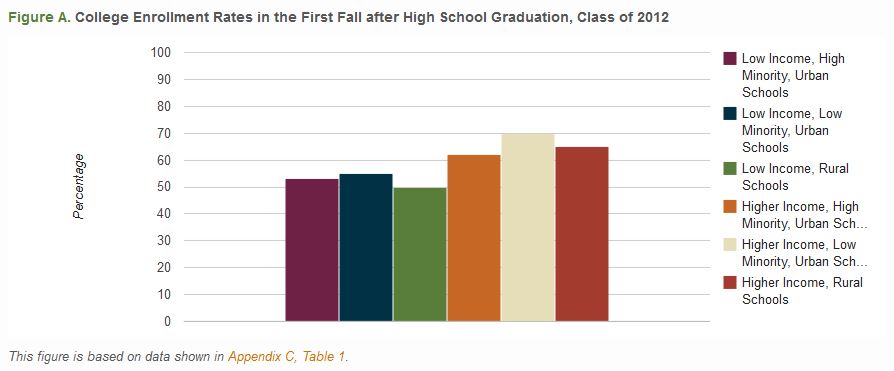
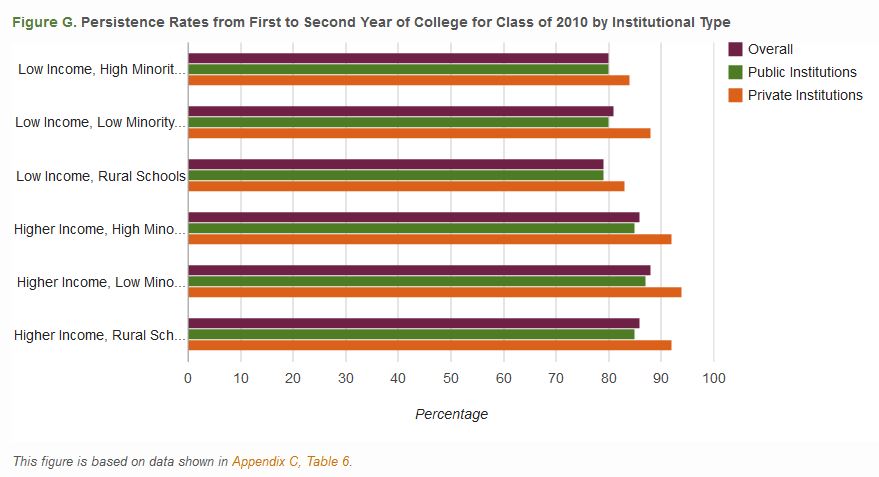
A new study titled “National College Progression Rates” was released today. It reported data on which demographic groups of high school students attended college and whether they were retained for a second year.

Two datasets are of particular importance. First, the figure below shows that lower income students are less likely to attend college. Students from low income, rural schools are the least likely to attend college (50%), while students from higher income, low minority, urban schools are the most likely (70%).

CSCubed College Enrollment


Second, students from higher income high schools were more likely to enroll for a second year than those from poorer areas.

CSCubed College Persistence

Lower income students from rural areas were the least likely to be retained. Overall 4 year colleges had a better retention rate than 2 year schools.

The Pros & Cons of Community College

by Michael Ciavarelli

In Report: Community College Attendance Up, But Graduation Rates Remain Low, Jason Koebler argues that while community colleges have had increased attendance they continue to have lackluster graduation rates. Community colleges are an affordable way for students who may not be financially able to pay for a traditional four year college or university to get a higher education. Their focus is to get students to graduate and  transfer into schools that have four year programs and ultimately get these students into the work force.

The number of students attending community college has increased dramatically in the past decade. In the year 2000, there were approximately 5.5 million students attending community colleges but in 2011 there were over 8 million. Even though there is a focus in quality and graduation and attendance has increased dramatically, not even half of the students that go to a community college graduate or transfer out to a 4 year school within 6 years. The increase in attendance may be due to the suffering economy because community colleges cost an average of less than $3000 per year compared to the over $8000 it costs at a four year college. The increase in attendance has lead to a rise in the percentage of the American workforce that has an associate degree, rising from 12% in 1973 to 27% in 2007.

Although there is an increase in attendance and community colleges are an affordable way to get an education there has to be major improvements made to make sure these incoming students graduate and move on to other programs to make the knowledge that they gain from these community colleges to pay off.