
Sallie Mae has just released its annual report on “How America Pays for College”. Conducted since 2008, the report is based on interviews with students and parents currently in college concerning the sources used to pay for higher education. The overall trends show that parents are contributing less, and relying more on scholarships/grants and cost-cutting measures to pay for college. Over the next several blogposts CSCubed will breakdown some of the important findings of this report.
Reducing the Costs of Higher Ed
Cutting Credit for AP Courses: Is This About Money?
A recent article in the Pittsburgh Tribune-Review by Kate Wilcox discusses an emerging trend where colleges are either cutting credit for high school AP courses or raising the standards for test scores. Colleges argue that these changes are necessary to guarantee that students attain the proper academic rigor in core courses. Dominick Frollini Jr., a high school chemistry teacher thinks there might be other motives:
“You’ve got to look at the perspective of AP and the perspective of the university,” he said. “Both have a vested interest in whether or not you take the exam or whether or not you take the course. There’s some money issues.”
Frollini touched on an issue bandied about on Internet blogs where some have questioned whether colleges are tightening AP requirements to ensure that students will have to pay for classes they might be able to forgo because of their AP courses.
A Little Humor on College Costs
The academic year is over, so how about a little summer humor to take our minds off the high cost of higher education? Comedian Don Novello, better known as Father Guido Sarducci, has the ultimate solution to reigning in costs: The 5 Minutes University. Does this model look sustainable?
New Jersey Poll on Higher Education Costs
A Philadelphia Inquirer article on a new poll from the Stockton Polling Institute shows that adults view cost as the largest obstacle to getting a college degree. The chart below shows that all other categories of problems related to obtaining a college education pale in comparison to paying for it.
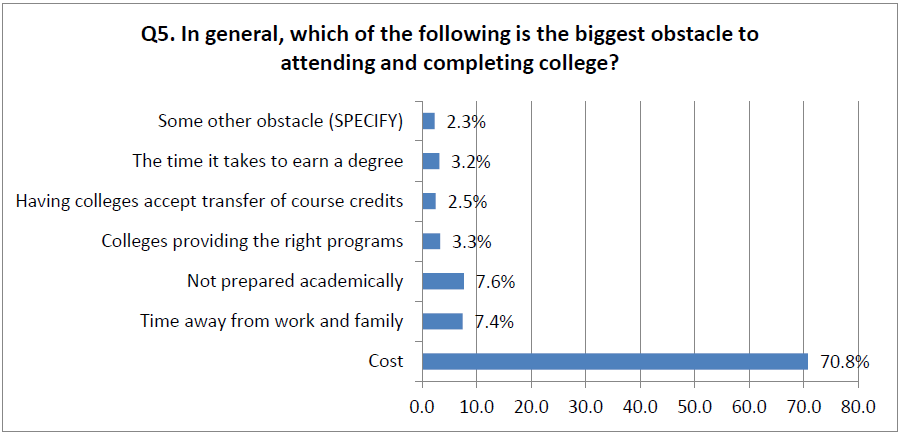
Not surprisingly, citizens place much more trust in university administrators to provide a quality education as opposed to state elected officials. However, they believe that both have the responsibility to make education more affordable. About 42% said that more state funding and financial aid is needed while 45% claim that cost control and more modest tuition increases would help more people achieve a university degree.
25 Ways to Reduce the Cost of College” Part II
The Center for College Affordability has produced a report entitled “25 Ways to Reduce the Cost of College”. This is the second of a three part series outlining their recommendations.
With college costs and withdrawal rates continuing to rise, it is obvious that major changes need to take place in higher education. Institutions are not student-centered and are falling behind on innovative methods of delivering education. Students withdraw for educational, as well as financial, reasons.
Here are some potential solutions to this problem:
- To improve education quality at the institutional level, it is necessary to stimulate the desire of teachers to improve and update their teaching methods. One way to motivate teachers is to abolish tenure. This would require full-time professors to be continually evaluated in order to continue their job. Tenure could be replaced with renewable long-term employment contracts with full-time professors, which allows for flexibility as well as job security.
- To measure teaching more easily, the state could mandate that teachers work a certain number of hours per week or institutions could reward quality teaching financially. Today, the national reputation of institutions is measured through research, whereas it should be through quality teaching.
- Institutions should also maximize the use of facilities and allocate space efficiently. While institutions see increases in tuition as ways of earning revenue, they should instead rent out classrooms or recreational centers in order to earn revenue.
- Another way to increase revenue is to outsource services through sale or long-term lease of capital assets to private entrepreneurs.
With institutions freeing up spending on teachers and facilities, institutions can cap tuition increases. Students can cut down on their costs through multiple ways.
- An innovative model is to encourage students to attend community college as it saves students money.
- The acceptance of community college credits also needs to more cost efficient and standardized.
- Institutions also need to standardize the credit transfer of dual enrollment programs like Advanced Placement, on-line education, and College Level Examination Program. Not all institutions accept alternative ways of earning college credit because they reduce potential tuition revenue. The federal government could mandate that institutions accept credits from dual enrollment programs.
Higher education is fraught with debt and withdrawal rates. Changes will need to be taken by institutions and enforced by institutions and the federal government. Therefore, roles in higher education need to be defined and all need to be held accountable.
A College Degree w/out Stepping Foot in the Classroom? CA is Thinking About It
CSC3 is always looking for ways to cut the costs of college education and ensure that students do not end up with insurmountable debt in their post-graduation years. However, this proposal in the California legislature to have test-only colleges might not be one of our potential solutions. Check out the story in the Los Angeles Times.
Where Should the Money Go?: Sports or Scholarships?
The University of Louisville is basking in the glory of winning the NCAA Men’s Basketball Championship last night. On Mike and Mike in the Morning (ESPN Radio & ESPN2) Mike Greenberg was upset that the NCAA would not allow the Louisville men’s basketball team to fly to New Orleans to watch the University’s women’s basketball team in the championship game tonight. He claimed that it was a ridiculous notion that attending the game was a special privilege that would in some way tarnish amateur college sports stars. Greenberg posted the following on Twitter:
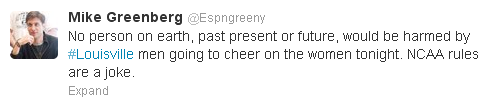
Perhaps. However, there is another way to look at this issue. According to ESPN’s own data calculator, the University of Louisville subsidizes its athletics programs to the tune of $2.15 million per year. A (very) rough calculation of the costs of the team attending the game in NOLA would look something like this:
16 players, 1 head coach, 3 assistant coaches (there are more “aids” listed on the team’s website, but we’ll stick with these numbers)
Roundtrip flight from Atlanta to New Orleans: $377 each = $7540 (if they fly charter it would be more expensive)
Moderately priced double rooms for the players (a total of 8) and single rooms for the coaches: $239 each = $2868
Expense money: the federal per diem in New Orleans is $71/day = $1420
This very conservative estimate adds up to $11,828. According to the University of Louisville’s website, the cost for in-state tuition, room and board is $18,470 for 2013-14. Consequently, instead of spending the money on a trip to a basketball game, those funds could be used to pay 2/3 of the cost of a full scholarship for a University of Louisville student. Perhaps this would be a better use of funds since the school is a state supported University.
“25 Ways to Reduce the Cost of College” Part 1
The Center for College Affordability has produced a report entitled “25 Ways to Reduce the Cost of College”. This is the first of a three part series outlining their recommendations.
Many colleges and universities make decisions that have long term effects on the cost of tuition. Several effective cost cutting measures are discussed below.
The idea of tenure has been around for decades but with the new increases in tuition, this option seems less useful. Consequently colleges are hiring more non-tenure track professors. Since these positions are still being filled it shows that even a non-tenured faculty position is still desirable. Consequently faculty does not need to be filled with tenure-track professors to retain a strong teaching force.
More innovative ways of teach could help limit institutional costs. Emphasizing more online courses would reduce costs, improve learning outcomes, and expand the access of students. This would increase the outreach to students all over the country who can enroll in the institution all while preserving the college’s reputation for academic integrity.
Textbooks are another source of college costs. Every semester students wait and wait and wait in hope their professor never uses the book because the prices are so expensive. If every college would utilize online sources for textbooks, this would reduce the cost and help lower the real cost of college. This could also take place in the library, where digitizing the system would increase access to online resources all while lowering cost.
Since many internet providers offer free email services, colleges should utilize these services rather than outsourcing to more expensive platforms.
States could also make the higher education system more cost efficient by subsidizing students through grants instead of directly providing money to colleges. Students could then use their grant money to shop for the highest quality/least expensive education, which would force colleges to be more competitive.
Overall, some believe that to cut costs the college needs to take a serious hit in its quality to make this happen. Actually this is not true. Turning competition from reputation to quality of teaching, by providing more information about education, could lead to colleges focusing more on the classroom and cutting unnecessary costs that improve the “appeal” of the college.
 know your college costs