Welcome to American Higher Education Where the Degrees are Made Up and the Major Doesn’t Matter

by Michael Pacitti

Second guessing your college major? Worrying if you’ll ever find a job in your field of study? Don’t worry- you’re not alone. If you’re like me, you didn’t have the slightest clue about what major to choose when entering college. As it turns out, a new study shows that your choice of major doesn’t necessarily result in a job in that desired field. CareerBuilder surveyed over 2,000 American workers with college degrees and found that 47% did not find a first job related to their college major. On top of that, 32% had never found a job in their major-specific field in their career!

However, just because these workers did not find a job in their field of study does not mean that they aren’t successful or happy. In fact, this same study showed that 64% are happy with their choice in major even if they weren’t employed in that field, and 61% were optimistic about finding their dream job.

Another study performed by the Federal Reserve Bank of New York found that only 27.3% of college graduates surveyed were working in their college major field. These alarmingly low percentages raise the question, “why bother stressing over a college major?” We select our major based on our interests and where we see ourselves going in the future, but the sad truth is that nearly half of us won’t even work in that selected field. Sometimes our interests change, sometimes it’s the surroundings that determine where we end up, and sometimes we simply have no control over where our careers will take us. The key is to find what you do love and pursue it.
Money or Education?

by Jessica Dembeck

Community college students who are looking to earn a four-year bachelor’s degree are at an extreme disadvantage, according to a study discussed in Paul Fain’s article “Third Try Isn’t A Charm ”. Many students enrolled at community colleges for one reason or another decide to “stop out” and take a break from their studies, and when that’s happened only once, majority of students will return to finish their degree. However, if students stop out more than once, the likelihood of them returning to finish their degree is extremely unlikely. Why are students not returning? Well, one reason could be because they’ve earned their associate’s degree, which for many students is a stopping point in education. In this study, students who discontinued enrollment in the community college were considered drop outs.

Many students who are going to community college do so because they are looking for a more affordable option to get their degree. While attending classes, majority of community college students are also holding down a full time job, and because of this, some students may withdraw from classes as a result from a pay increase. However, one solution offered in this article is a “work less, study more” model. So now the question becomes: which is more important – your education or maintaining your job? But should a student ever have to choose between the two?

What You Write on the FASFA Can and Will Be Used Against You

by Lauren Robson

College essays, applications, and deadlines, filling out the FAFSA, managing current classes. As if the college selection process isn’t stressful enough, high school seniors now have to worry about colleges looking at how they ranked potential schools on the FAFSA. Does this ranking really have an impact on the student’s future? The truth is that it does.

Colleges have access to these FAFSA rankings, thus influencing how they will approach their applicants. How? Well it is quite simple. If their institution is ranked towards the top, universities will not offer as much financial aid; the student wants to go there and will hopefully still want to go there. If their institution is ranked towards the bottom, they might not even want to bother. What are the chances that their school will jump up nine spots to capture number one? This chance is extremely slim, therefore colleges may not even think about accepting the student or offering much financial aid. If their institution is ranked towards the upper middle, and the college really wants the student, they might offer a good amount of financial aid to try to reel the student in.

Some people say that the FAFSA reports are released too late for colleges to utilize them in this manner, however it cannot be ruled out. Colleges with lower budgets may look to find out which students are interested, so they aren’t wasting their time and efforts. As Deborah Fox says in the article Colleges May Penalize You for Ranking Financial Aid Applications “colleges have the goal of admitting the best students they possibly can at the best price they possibly can.”

Social Media in the College Application Process

by Marie Herb 

When applying for colleges, students often use many online resources to find out about schools they are considering. On the flip side, colleges are also using online resouces (including Facebook, Twitter, Instagram, and even google) to learn more about who is applying to their schools and what kind of image these students will bring to these respective schools. Schools are increasingly uses social media sites as a way to “protect” themselves from students who could destoy the school’s reputation as Bauerlein’s article explains.

Constantly, hearing about some of the tragic and terrible events that occur on college campuses at the hands of college students, colleges should have a right to know who is applying to their school “beyond” an essay. Social media plays a key part in many teenager’s lives, which is why it is an interesting and key part of the application process. As more schools are admitting to using social media as a factor that is considered when applying to schools, perhaps more students will think twice about posting inappropriate materials online. While this does not solve the problem, of teenagers acting in ways that colleges do not see as positive, perhaps it could help make them learn to be careful what to post on social media sites.

New Survey on Who Goes to College and Whether They Stay

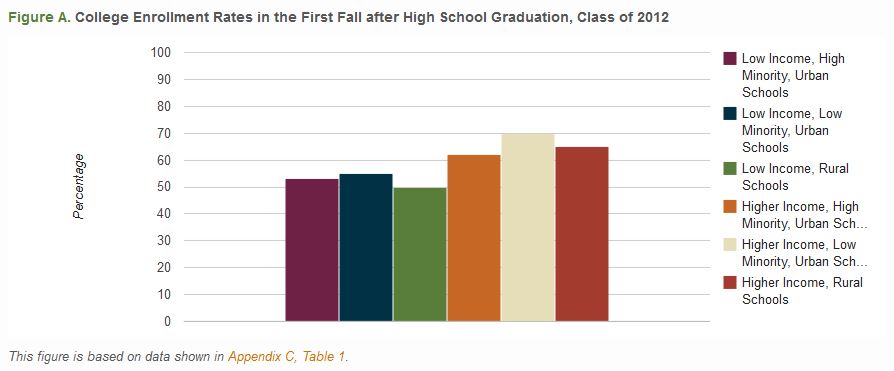
A new study titled “National College Progression Rates” was released today. It reported data on which demographic groups of high school students attended college and whether they were retained for a second year.

Two datasets are of particular importance. First, the figure below shows that lower income students are less likely to attend college. Students from low income, rural schools are the least likely to attend college (50%), while students from higher income, low minority, urban schools are the most likely (70%).

CSCubed College Enrollment


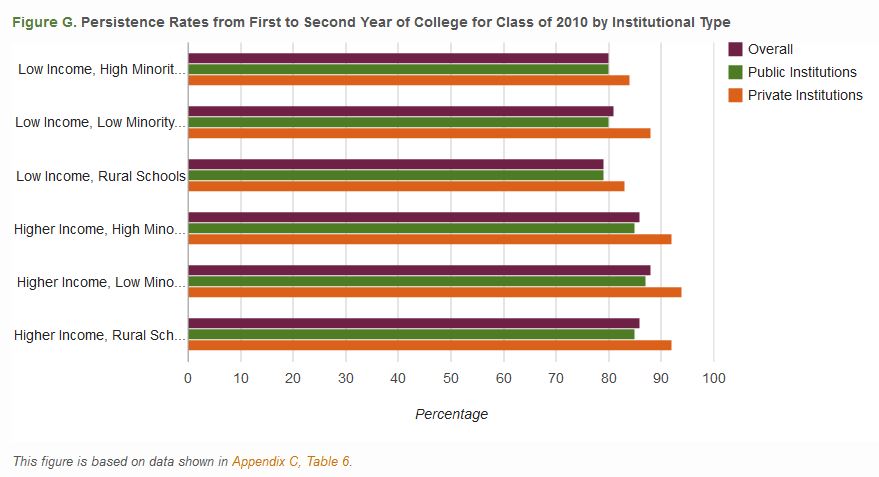
Second, students from higher income high schools were more likely to enroll for a second year than those from poorer areas.

CSCubed College Persistence

Lower income students from rural areas were the least likely to be retained. Overall 4 year colleges had a better retention rate than 2 year schools.

Is a 4-Year College Right for You? The American Public Believes So!

by Taylor O’Connor

People have debated the importance of higher education vs. vocational education for years. Is it more important to have broad, well-rounded abilities and skills? Or is it more practical and beneficial to train specifically in your field to be as well versed in your area as possible? The answer the majority of Americans choose may surprise you.

According to an article written by Michael Stratford, new surveys show that a large portion of the American public and business leaders believe that the importance of education lies in being well-rounded and having a multitude of skills rather than having just industry specific skills. These surveys show that businesses value skills such as written communication and problem solving over skills specific to that vocation. More importantly, the survey found that only 62% of respondents value higher education. They also said that the current system is poorly preparing college students for post graduation work. Stratford’s article additionally reported that the 41% of the American public, down 8% from last year, believes that online education offers “similar quality” in comparison to conventional colleges.

Thinking of the complaints of price for higher education, one would not think that the majority of people would promote a traditional four year education over a cheaper two year vocational school if applicable. There are some jobs that understandably need four year degrees, like education or nursing. But if someone wants to work with electronics, why not go to a two year vocational school instead of a four year program, racking up much more debt? Yes, being a well-rounded individual is beneficial to society as a whole, but if one can do their job just as effectively without digging themselves into a hole, then that should be the route more people are taking.


Increased Demand for College WiFi – But at What Cost?

by Vadim Belogorodsky

As an Electrical Engineering major, Carl Straumshein’s “Device Explosion” caught my eye.  Straumshein details the challenges many university Chief Information Officers (CIO) face when analyzing their wifi systems. Many deal with the same problem: Disappointment voiced by students over the quality of the wifi systems on campus. The article states that many students are spoiled at home with near-perfect wifi systems and expect the same when they move to college. Though the concept of increasing coverage may seem simple, the topic becomes a hot button when budgets and resources become involved.

In the past decade with the invention of smart phones, more affordable laptops, and internet based gaming systems the article mentions on average each student brings 2.5 wifi capable devices. Each professor brings about 2 devices on average. So looking at this data, one might suggest, “Hey just add more routers” and the problem with slow unreliable coverage will disappear. The problem really is the fact that people don’t realize there is a constant amount of bandwidth available for all the devices on campus and as more devices use a portion up, the quality of the system decreases.

Less money is being allocated for technical services such as wifi as universities tighten budgets. So the problem becomes a balance of how much to spend on a system most certainly everyone uses or whether to allocate the money to another project and deal with poor wifi reception.Colleges these days cannot afford to replace full systems and simply spend their budgets on repairing aged equipment. One college spent their budget on replacing old systems which allows for better quality of wifi by modernizing the equipment and severely lowering maintenance costs hoping that this will pay off in the long run. At a time when people are wondering whether college is too expensive or even worth it, little things such as wifi systems make the differences

With the advance of affordable tablets, experts expect the number of wifi devices to jump on campus causing future debate on what path to take with current systems at various universities. Even around Widener’s campus, complaints about the wifi are heard daily. Who knows what will happen in the future.

It’s Not About Where You Go, It’s About What You Study

By Lauren Robson

“What do you want to be when you grow up?” It’s the question every indecisive person, much like myself, dreaded being asked through elementary school, middle school, and high school. Senior year, come graduation, the questions tend to drift. It’s no longer about what you’re studying and more of where you’re going to study. If it’s not an Ivy League, no one seems to care or even believe that you will be successful. The truth is that people look down on small, under the radar schools. What if the truth was that they should stop worrying about where they were going and go back to worrying about the why?

According to Jon Marcus’s article, “Elite degrees don’t necessarily earn more, study finds,” students don’t need to attend elite colleges to be successful. On average, the students who attended less-prestigious schools earned about the same as their Ivy-League counterparts. There are also graduates out there with associate’s degrees that are actually earning more money (up to $11,000 more) than some graduates with bachelor’s degrees. The future paychecks of students with certain majors look more fortunate than others’ as well, no matter what school they attend. Majors such as engineering, business, and nursing are ranking in the most well-paid majors while those in liberal arts, such as philosophy and music, are on the lower side of the spectrum.

It’s about time people stop judging futures by the college one attends. The college does not determine the success of the individual, rather it is what they take from the college that will give them the edge.