Should Some College Courses Cost More than Others? One CA Legislator Thinks So

Higher education has hit a rough patch in California due to the state’s budget woes. A recent article in Inside Higher Education highlights the difficulties budget cuts have caused and one potential solution: two-tiered pricing for courses at community colleges.

Over the last five years, $1.5 billion has been cut from the California community college system. According to another article in Inside Higher Education

[s]ince 2007, the state’s 112 community colleges have been forced to substantially reduce staffing, which in turn led to a 21 percent dip in course offerings…. And first-time students were the most likely to be turned away, with a 5 percent enrollment decline even as the number of California high school graduates increased by 9 percent.

Cutting 100,000 courses out of the community college system’s offerings has created a shortage in many disciplines. Consequently

Das Williams, a Democrat who represents Santa Barbara in California’s State Assembly, introduced [a] proposal last month. It would allow colleges to offer nonresident tuition rates – about $200 per credit compared to the standard $46 per credit – for courses in summer or winter sessions.

Mr. Williams argues that differential tuition will help ease budget cuts to community colleges and also students to save money by getting their two year degree more expeditiously:

“These same courses at the lower fees would still be offered during the regular academic year. But if students choose to pay a higher fee during a summer or winter session, this would allow them that opportunity….This option would save students potentially thousands of dollars in living expenses by allowing them to take a course and transfer, rather than hang around for a year waiting for a class to open up.”

Critics of the plan argue that it will change the nature of the community college system which has been seen as a gateway to higher education for lower income students. They argue that the differential pricing system would cater to wealthier students and marginalize those of more modest means.
CSCubed Joins AICUP 2013 Student Lobby Day in Harrisburg

College Students Concerned by College Costs is joining the Association of Independent Colleges and Universities of Pennsylvania’s Student Lobby Day on April 16 in Harrisburg. We will be advocating for the Middle Income Student Debt Reduction Act that is currently before the Pennsylvania Legislature.  For more information on the act please yesterday’s post.

We’ll be live tweeting the events on Twitter @CSC_Cubed. Send us your pictures and experiences there or use #studentlobbyday.

Please Support the Pennsylvania Middle Income Student Debt Reduction Act

College Students Concerned by College Costs is supporting the Middle Income Student Debt Reduction Act currently being debated in the Pennsylvania Legislature. The Senate version (SB 420) is being sponsored by Senators Ward and Alloway and the House version will be introduced shortly by Representative Quinn (see the co-sponsorship memorandum here).

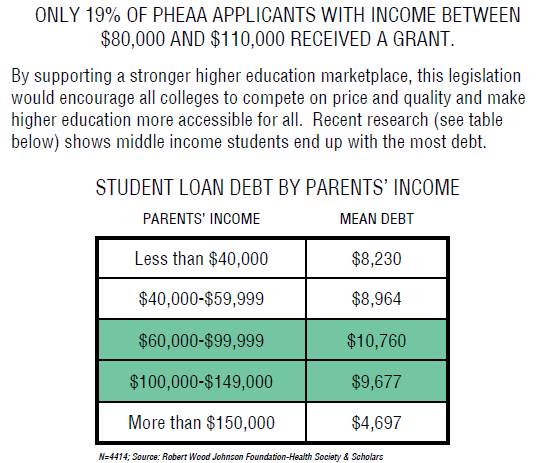
This law is aimed at helping families with incomes between $80,000-110,000 pay for college. Currently, this demographic finishes college with the highest average student loan debt of any income group.

AICUP_Middle_Income_Chart

The legislation proposes to reinstate $36 million that was cut from PHEAA funding last year as a new program dedicated to giving grants to families in this income group. For a complete discussion of the merits of the legislation, please see a video from Senators Alloway and Ward, as well as the Association of Independent Colleges and Universities of Pennsylvania’s website.

New Jersey Poll on Higher Education Costs

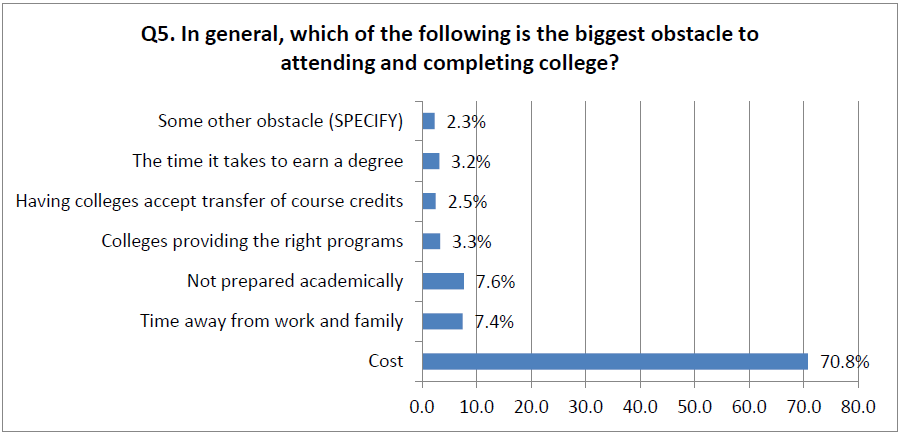
Philadelphia Inquirer article on a new poll from the Stockton Polling Institute shows that adults view cost as the largest obstacle to getting a college degree. The chart below shows that all other categories of problems related to obtaining a college education pale in comparison to paying for it.

Chart_from_Stockton_Poll

Not surprisingly, citizens place much more trust in university administrators to provide a quality education as opposed to state elected officials. However, they believe that both have the responsibility to make education more affordable.  About 42% said that more state funding and financial aid is needed while 45% claim that cost control and more modest tuition increases would help more people achieve a university degree.


25 Ways to Reduce the Cost of College” Part II

The Center for College Affordability has produced a report entitled “25 Ways to Reduce the Cost of College”. This is the second of a three part series outlining their recommendations.

With college costs and withdrawal rates continuing to rise, it is obvious that major changes need to take place in higher education. Institutions are not student-centered and are falling behind on innovative methods of delivering education. Students withdraw for educational, as well as financial, reasons.

Here are some potential solutions to this problem:

  • To improve education quality at the institutional level, it is necessary to stimulate the desire of teachers to improve and update their teaching methods. One way to motivate teachers is to abolish tenure. This would require full-time professors to be continually evaluated in order to continue their job. Tenure could be replaced with renewable long-term employment contracts with full-time professors, which allows for flexibility as well as job security.
  • To measure teaching more easily, the state could mandate that teachers work a certain number of hours per week or institutions could reward quality teaching financially. Today, the national reputation of institutions is measured through research, whereas it should be through quality teaching.
  • Institutions should also maximize the use of facilities and allocate space efficiently. While institutions see increases in tuition as ways of earning revenue, they should instead rent out classrooms or recreational centers in order to earn revenue.
  • Another way to increase revenue is to outsource services through sale or long-term lease of capital assets to private entrepreneurs.

With institutions freeing up spending on teachers and facilities, institutions can cap tuition increases. Students can cut down on their costs through multiple ways.

  • An innovative model is to encourage students to attend community college as it saves students money.
  • The acceptance of community college credits also needs to more cost efficient and standardized.
  • Institutions also need to standardize the credit transfer of dual enrollment programs like Advanced Placement, on-line education, and College Level Examination Program. Not all institutions accept alternative ways of earning college credit because they reduce potential tuition revenue. The federal government could mandate that institutions accept credits from dual enrollment programs.

Higher education is fraught with debt and withdrawal rates. Changes will need to be taken by institutions and enforced by institutions and the federal government. Therefore, roles in higher education need to be defined and all need to be held accountable.

A College Degree w/out Stepping Foot in the Classroom? CA is Thinking About It

CSC3 is always looking for ways to cut the costs of college education and ensure that students do not end up with insurmountable debt in their post-graduation years. However, this proposal in the California legislature to have test-only colleges might not be one of our potential solutions. Check out the story in the Los Angeles Times.

College Debt, Planning and Just Saying No

NPR’s Morning Edition conducted a valuable interview on college debt with Ron Lieber of the New York Times (Debt and the Modern Parent of College Kids).  Mr. Lieber provided tough, but common sense,  solutions to the problems of financing education. Two parts of the discussion stand out.

First, he suggested that parents think of funding college in three 33% increments (the 20/20/20 plan if education were to cost $60K over four years) . First, parents could save one third of the costs of college over the period of 18 years through a manageable savings plan. Second, they could pay 1/3 of the costs out of pocket while their child was in school. He stated

“It might mean some sacrifices — some very careful budgeting, a lot of rice and beans on the table — but it’s doable.”

The final third of higher education costs could be subsidized through federal loans.  The 20/20/20 plan seems sensible because

[w]hen you start to divide it into chunks, it starts to seem at least within the realm of the possible.

Mr. Lieber’s second useful suggestion involved a bit of pragmatic toughlove for parents. He says that sometimes emotions have to be trumped by rationality when children get accepted to a top tier school.

[T]here’s this feeling of ‘Can I or should I say no to my child who wants to go to a $60,000-a-year school when they’ve already gotten admission to the flagship public university in our state that only costs $20,000?’ And then there’s the question of ‘Is it worth it? What am I getting for the extra $40,000 and would we be able to pay our own debt back if we were to support the dream of our child?’ These are all deeply emotional decisions, and you have to begin by acknowledging that it’s feelings that are on the table first before you look at the hard science of the numbers.

Please listen to the rest of the story for more information on what types of loans to take out and whether it is worth it to borrow against retirement.

Where Should the Money Go?: Sports or Scholarships?

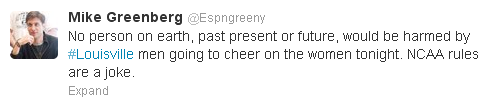
The University of Louisville is basking in the glory of winning the NCAA Men’s Basketball Championship last night. On Mike and Mike in the Morning (ESPN Radio & ESPN2) Mike Greenberg was upset that the NCAA would not allow the Louisville men’s basketball team to fly to New Orleans to watch the University’s women’s basketball team in the championship game tonight. He claimed that it was a ridiculous notion that attending the game was a special privilege that would in some way tarnish amateur college sports stars. Greenberg posted the following on Twitter:

ESPNGREENY_TWITTER

Perhaps. However, there is another way to look at this issue. According to ESPN’s own data calculator, the University of Louisville subsidizes its athletics programs to the tune of $2.15 million per year. A (very) rough calculation of the costs of the team attending the game in NOLA would look something like this:

16 players, 1 head coach, 3 assistant coaches (there are more “aids” listed on the team’s website, but we’ll stick with these numbers)

Roundtrip flight from Atlanta to New Orleans: $377 each = $7540 (if they fly charter it would be more expensive)

Moderately priced double rooms for the players (a total of 8) and single rooms for the coaches:  $239 each = $2868

Expense money: the federal per diem in New Orleans is $71/day = $1420

This very conservative estimate adds up to $11,828.  According to the University of Louisville’s website, the cost for in-state tuition, room and board is $18,470 for 2013-14.  Consequently, instead of spending the money on a trip to a basketball game, those funds could be used to pay 2/3 of the cost of a full scholarship for a University of Louisville student. Perhaps this would be a better use of funds since the school is a state supported University.

Young Adult Borrowing is Down, While Student Loan Debt is Up

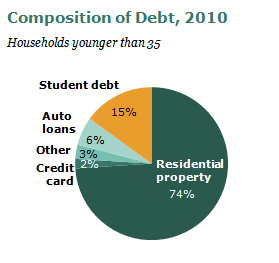
The Pew Research Center recently released Young Adults After the Recession: Fewer Homes, Fewer Cars, Less Debt. The study examines the borrowing habits of younger Americans over the last decade. The report concludes that they are taking on less debt, primarily in the areas of home mortgages and car loans. In part this is the consequence of delayed marriage and household formation among the younger demographic group. The Pew study found that “the median debt of households headed by those younger than 35 fell from 2001 ($17,938) to 2010 ($15,473).”

Unfortunately, the only type of debt to increase in recent years has been from student loans. Pew found that

Student debt was the only major type of debt to increase in prevalence among young households during the recession. In 2007, 34% of young households had outstanding student debt. By 2010, 40% of younger households had student debt. However, the median amount owed by households with student debt fell from $14,102 in 2007 to $13,410 in 2010.

This number is up substantially from 2001 when only 26% of younger households had outstanding student loan debt. Debt from student loans has also increased as a proportion of outstanding debt: from 7% in 2001 to 15% in 2010.

Composition_of_Young_Household_Debt

“25 Ways to Reduce the Cost of College” Part 1

The Center for College Affordability has produced a report entitled “25 Ways to Reduce the Cost of College”. This is the first of a three part series outlining their recommendations.

Many colleges and universities make decisions that have long term effects on the cost of tuition. Several effective cost cutting measures are discussed below.

The idea of tenure has been around for decades but with the new increases in tuition, this option seems less useful. Consequently colleges are hiring more non-tenure track professors. Since these positions are still being filled it shows that even a non-tenured faculty position is still desirable. Consequently faculty does not need to be filled with tenure-track professors to retain a strong teaching force.

More innovative ways of teach could help limit institutional costs. Emphasizing more online courses would reduce costs, improve learning outcomes, and expand the access of students. This would increase the outreach to students all over the country who can enroll in the institution all while preserving the college’s reputation for academic integrity.

Textbooks are another source of college costs. Every semester students wait and wait and wait in hope their professor never uses the book because the prices are so expensive. If every college would utilize online sources for textbooks, this would reduce the cost and help lower the real cost of college. This could also take place in the library, where digitizing the system would increase access to online resources all while lowering cost.

Since many internet providers offer free email services, colleges should utilize these services rather than outsourcing to more expensive platforms.

States could also make the higher education system more cost efficient by subsidizing  students through grants instead of directly providing money to colleges. Students could then use their grant money to shop for the highest quality/least expensive education, which would force colleges to be more competitive.

Overall, some believe that to cut costs the college needs to take a serious hit in its quality to make this happen. Actually this is not true.  Turning competition from reputation to quality of teaching, by providing more information about education, could lead to colleges focusing more on the classroom and cutting unnecessary costs that improve the “appeal” of the college.